30
Oct
Magnetic steel components are widely used in precision motors, generators, and electronic devices. These parts often require tight tolerances, smooth surfaces, and high grinding efficiency.
This article presents an optimized grinding solution provided by MORE SUPER HARD, designed for high-speed magnetic steel machining with spindle speeds of 12,000–20,000 RPM, a stock removal of 0.3 mm, and a surface roughness requirement of Ra 0.2–0.3 μm.

Magnetic steel, typically sintered NdFeB (neodymium-iron-boron) or SmCo (samarium-cobalt), is known for its extremely high hardness and brittleness. It provides excellent magnetic performance but presents several machining challenges:
High hardness and brittleness – prone to edge chipping and cracking during grinding.
Poor thermal conductivity – localized heat can cause demagnetization or microcracks.
High chemical reactivity – NdFeB is sensitive to moisture and prone to oxidation.
Strong magnetism – easily attracts chips and abrasive dust, affecting precision and cooling.
These factors require a grinding wheel with excellent sharpness, self-dressing ability, and heat resistance.

Magnetic steels are key materials in various industries, including:
Electric vehicle drive motors (permanent magnet synchronous motors)
Industrial servo motors and robotics
Wind turbine generators
Consumer electronics (smartphones, HDD motors, speakers)
Medical equipment and precision sensors
With the growth of the EV and automation markets, high-efficiency precision grinding of magnetic materials has become increasingly critical.


A single grinding wheel for both efficiency and surface finish, suitable for one-pass processing.
Recommended Configuration:
Abrasive: Diamond
Bond: Resin bond (essential choice)
Metal bonds tend to overheat and burn the workpiece at high speeds, while resin bonds provide elasticity, cooling, and self-sharpening ability.
Grit size: #320 – #400
Prefer #400 for better surface finish (Ra 0.3 μm); use #320 for higher removal rate if efficiency is prioritized.
Bond hardness: Medium-soft (J, K, or L)
Ensures continuous sharpness and prevents loading or thermal damage.
Concentration: 75% – 100%
Provides sufficient cutting edges while maintaining good chip flow and cooling.
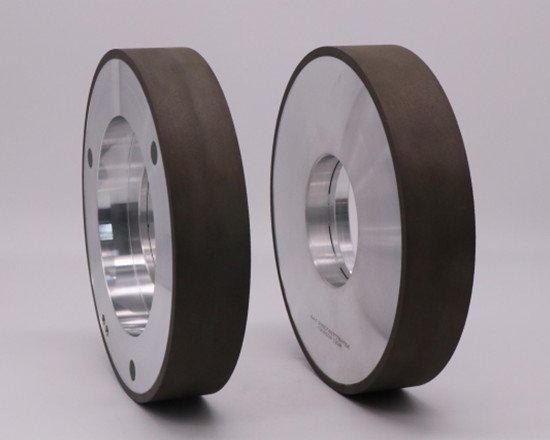
Resin bond diamond grinding wheel, grit #400, hardness K, concentration 75%–100%.
Suitable for high-speed, high-precision magnetic steel grinding where efficiency and quality are both required.


A two-stage process—rough grinding followed by fine grinding—can further improve consistency and surface quality.
Rough Grinding Wheel:
Abrasive: Diamond
Bond: Resin bond
Grit: #150 – #220
Hardness: L – M
Concentration: 75% – 100%
Purpose: Rapid removal of approximately 0.25 mm stock with high efficiency.
Fine Grinding Wheel:
Abrasive: Diamond
Bond: Resin bond
Grit: #600 – #800
Hardness: J – K
Concentration: 75% – 100%
Purpose: Achieve Ra 0.2–0.3 μm surface finish with stable precision and low damage.This method reduces wheel wear, minimizes thermal load, and ensures excellent dimensional accuracy and mirror-like finish.

Cooling is essential – Use clean, adequate coolant to control temperature and prevent demagnetization.
Dynamic balancing – Ensure the grinding wheel is precisely balanced at high speeds (up to 20,000 RPM).
Regular dressing – Perform light and frequent dressing to maintain sharpness and profile accuracy.
Grinding magnetic steel under high-speed conditions requires a wheel with high sharpness, good heat resistance, and self-dressing ability.
MORE SUPER HARD provides tailored resin bond diamond grinding wheel solutions that deliver high efficiency, minimal burn, and superior surface quality.We provide technical support for magnetic material grinding applications worldwide.