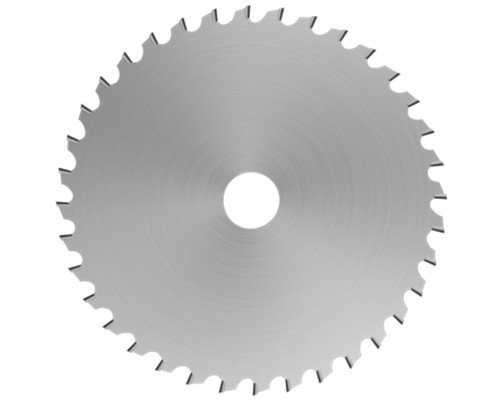
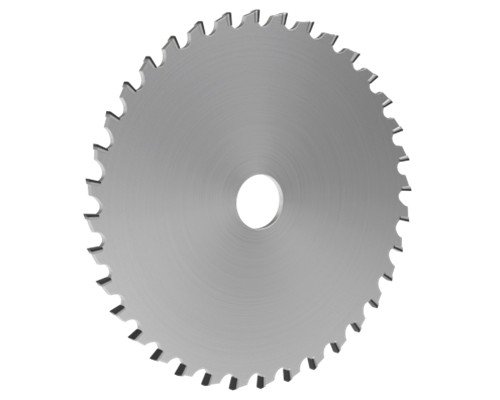
Cutting HPL (High-Pressure Laminate) boards demands exceptional precision and durability. Traditional carbide blades wear out quickly and produce chipping — leading to rework, machine downtime, and higher production costs.
Our PCD Saw Blades for HPL Boards are engineered to solve these challenges with unmatched accuracy, ultra-long lifespan, and superior surface finishing.
With premium polycrystalline diamond cutting tips, advanced TCG tooth design, and vibration-reducing slots, these blades deliver smooth, chip-free, and stable HPL cutting in demanding industrial applications.
| Parameter | Details |
| Diameter Options | 300mm, 350mm, 400mm (300mm most common for HPL) |
| Number of Teeth | 96T, TCG (Triple Chip Grind) geometry |
| Bore Diameter | 30mm standard (custom bores available) |
| Diamond Grain Size | 2–25 μm PCD (2–10 μm for finish, 10–25 μm for long life) |
| Suitable Material Thickness | 0.5mm – 30mm HPL boards |
| Recommended RPM | 3000–6000 RPM (300mm: optimal 4500–5500 RPM) |
| Blade Thickness | 3.2mm |
| Kerf Width | 2.2mm |
| Body Material | 75Cr1 alloy steel/Cobalt-Bonded Tungsten Carbide |
| Hardness | 42–48 HRC |
| Welding Method | Vacuum Brazed |
| Coating | Anti-stick, friction-reducing protective coating |
1. Exceptional Wear Resistance & Cost Efficiency
60–75× longer lifespan than carbide-tipped blades.
Up to 4000 hours of continuous HPL cutting before sharpening.
Reduces tool changes, labor, and downtime.
Overall tooling costs drop by 70–80% in high-volume operations.
2. Chip-Free Precision Cutting
Surface finish as fine as Ra ≤ 0.8 μm.
Eliminates the need for secondary sanding.
Ideal for decorative HPL surfaces used in high-end applications.
TCG tooth design minimizes splintering on both top and bottom surfaces.
3. Higher Productivity & Faster Feed Rates
Maintains sharp edges significantly longer.
Supports 30–50% faster feed rates than carbide blades.
Stable performance across long production runs.
4. Efficient Heat Dissipation & Chip Evacuation
Laser-cut damping slots reduce vibration and temperature.
Anti-stick coating prevents resin buildup.
Protects blade integrity during continuous HPL cutting.
5. Reduced Material Waste
Narrow kerf and precise edge control maximize material usage.
Ideal for expensive decorative laminates.
PCD vs. Carbide Saw Blades
| Feature | PCD | Carbide |
| Lifespan | 60–75× longer | Short |
| Surface finish | Ra ≤ 0.8 μm | 2.5–3.2 μm |
| Cost per cut | Lowest | High |
| Feed rates | Faster (30–50%) | Slower |
| Ideal for HPL? | Yes | Risk of chipping, overheating |
Installation Tips
Confirm machine arbor matches bore diameter.
Use correct bushings if needed.
Avoid over-tightening flange nuts.
Test run for 30 seconds before cutting.
Operating Guidelines
Maintain recommended RPM range.
Use mist cooling or airflow when possible.
Suggested feed rate for 12mm HPL: 3–5 m/min.
Allow the blade to cut without forcing material.
Maintenance
Clean after each use with bristle brush or mild solvent.
Inspect for wear, cracks, or chipped tips.
Store vertically in protective case.
Sharpen professionally after performance declines
(typical resharpening cycles: 4–6 times).
| Issue | Cause | Solution |
| Chipping edges | Dull blade or inconsistent feed | Replace blade / adjust feed |
| Burn marks | Heat buildup or slow feed | Clean blade, increase feed speed |
| Excessive vibration | Imbalance or loose mounting | Reinstall, inspect arbor |
| Premature wear | Incorrect speed/feed or abrasive contaminants | Adjust parameters |
Upgrade your HPL processing with industrial-grade PCD saw blades designed for durability, precision, and maximum cost savings.
Contact us for pricing, custom sizes, or bulk orders!