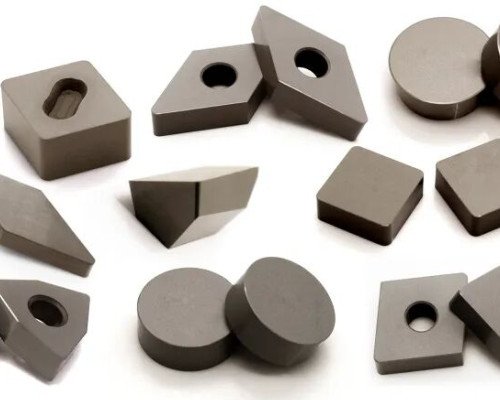
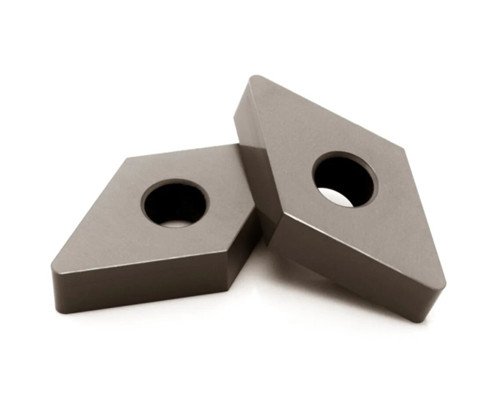
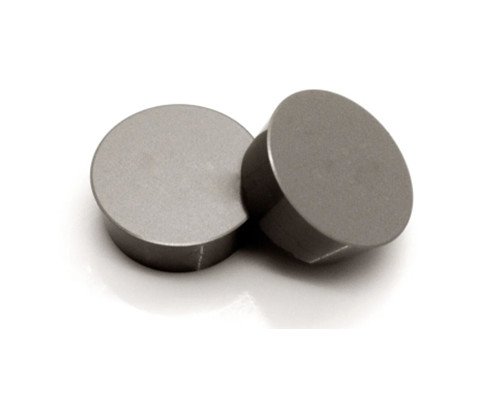
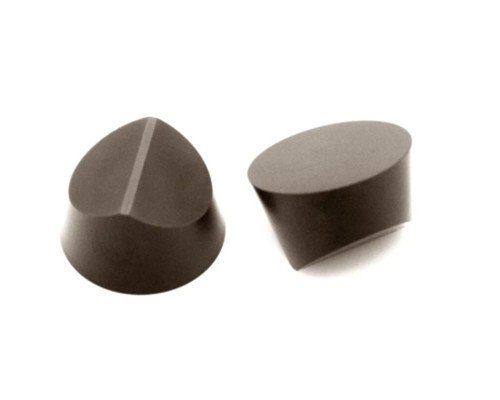
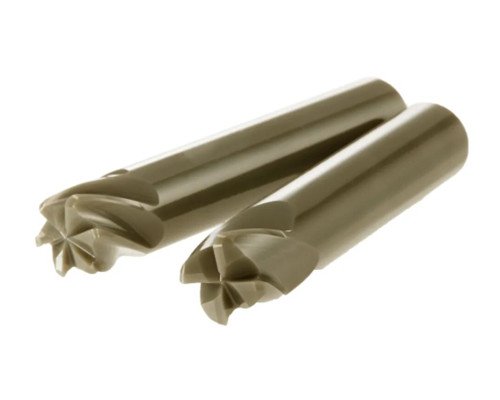
Sialon ceramic (a solid solution of Si₃N₄-Al₂O₃) is a high-performance cutting tool material independently researched, developed and manufactured by our company. It features high hardness (≥1800 HV), high temperature resistance (≥1300 °C), excellent wear and corrosion resistance, and superior thermal shock resistance, with no adhesion to non-ferrous metals and superalloys. Particularly suitable for high-speed cutting, heavy-duty cutting and interrupted cutting, it is the first choice for high-speed dry machining of cast iron and nickel-based superalloys in the aerospace and automotive manufacturing industries.
| Performance Indicator | Sialon Ceramic Inserts | Cemented Carbide/Coated Cemented Carbide | Performance Advantages |
| Hardness | HRA93-95 (HV1800-2200) | HRA89-92 | Close to CBN, 5-10 times higher wear resistance |
| Heat Resistance Temperature | ≥1300℃ | ≤800℃ | Suitable for high-speed dry cutting without cutting fluid |
| Fracture Toughness (KIC) | 6-8 MPa·m¹/² | 3-4 MPa·m¹/² (Traditional Ceramics) | 3 times higher chipping resistance, suitable for interrupted cutting |
| Thermal Expansion Coefficient | 2.8-3.2×10⁻⁶/℃ | 4.5-6.5×10⁻⁶/℃ | Excellent thermal shock resistance, reducing crack generation |
| Typical Cutting Speed | Nickel-based alloys: 300-800m/min; Cast iron: 800-1500m/min | Nickel-based alloys: 50-120m/min; Cast iron: 150-300m/min | 3-10 times higher machining efficiency |
| Tool Life | 5-8 times that of cemented carbide; 5-10 times that of coated cemented carbide | Basic level | Reduce tool change frequency and improve productivity |
Supplementary Performance Description
•Solid Solution Strengthening + Self-Toughening Structure: Interwoven β-Si₃N₄ columnar crystals achieve high toughness, avoiding the brittleness problem of traditional ceramics.
•Low Affinity: No adhesion to Inconel 718, GH4169 and other materials, preventing built-up edge and ensuring machining surface quality.
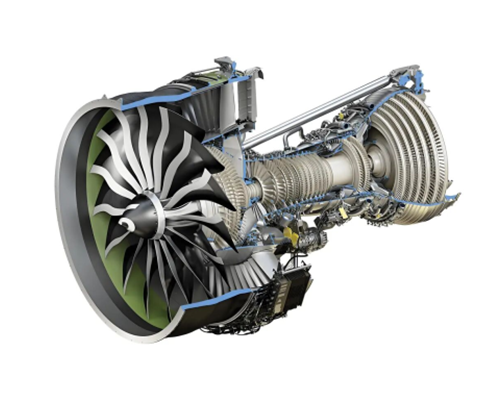
•High-Temperature Chemical Stability: Oxidation resistance at 1300℃, suitable for long-term machining of hot-end components of aero-engines.
| Insert Model | Applicable Machining | Cutting Recommendation | Remarks |
| RNGN120700T01020 | Turning of nickel-based superalloys (GH4169/Inconel718) | ap=1mm, f=0.15mm/rev, Vc=250m/min | Roughing/Semi-Finishing |
| RPGN0903E040 | End milling of aero-engine blades | 3 inserts, Dc=35mm, Vc=928m/min, n=11400r/min | High-speed dry cutting/Minimum Quantity Lubrication (MQL) |
Note: Custom non-standard inserts can be provided according to customers’ machining conditions (material, cutting parameters, processes); a full range of turning, milling and grooving inserts are available.
High-Speed Cutting of Nickel-Based Superalloys (Core Scenario)
•Machining Materials: Inconel 718, Hastelloy C276, GH4169 and other nickel-based superalloys
•Typical Workpieces: Turbine disks, blades and combustion chambers of aero-engines; hot-end components of gas turbines
•Working Conditions: High-speed dry cutting/Minimum Quantity Lubrication (MQL), cutting speed 300~800m/min
•Effects: 8-10 times higher machining efficiency, 5-8 times longer tool life than cemented carbide, no adhesive wear
High-Speed Dry Cutting of Cast Iron (Replacing Coated Cemented Carbide)
•Machining Materials: Gray cast iron (HT200/HT300), ductile iron (QT450/QT600), compacted graphite iron and other wear-resistant cast irons
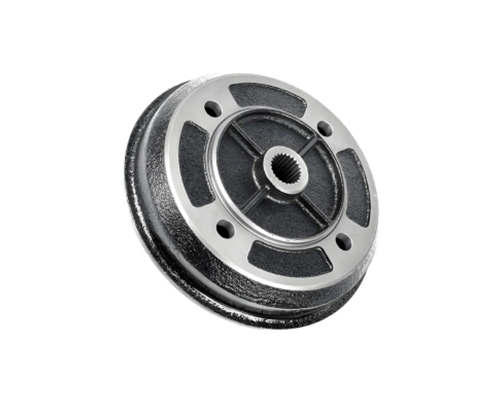
•Typical Workpieces: Auto engine blocks, brake discs, machine tool beds
•Working Conditions: Cutting speed 800~1500m/min, no cutting fluid
•Effects: Graphite self-lubrication, 5-10 times longer tool life, no waste liquid discharge
•Workpiece: GH4169 bar (nickel-based superalloy, equivalent to Inconel 718)
•Parameters: ap=1mm, f=0.15mm/rev, Vc=250m/min
•Results: Flank wear <0.3mm, no chipping after 100 minutes of machining, surface roughness Ra<1.6μm
•Workpiece: Aero-engine blade (Inconel 718 nickel-based superalloy)
•Parameters: 3 inserts, Dc=35mm, ap=1mm, ae=5~15mm, fz=0.13mm/t, Vc=928m/min, n=11400r/min
•Results: Machining efficiency increased by 9 times, tool life is 6 times that of cemented carbide