02
Jun
Industrial ceramics including alumina, zirconia, silicon carbide, silicon nitride, and electronic ceramic substrates have a microhardness of HV2250–3000 and a Mohs hardness of 8–9. These ultra-hard brittle materials cannot be stably processed by conventional tools such as high-speed steel cutters, tungsten carbide blades, and ordinary resin grinding wheels. Traditional cutting methods often produce vibration stress and thermal stress, resulting in edge defects, hidden microcracks, and low dimensional consistency, which restrict mass production and high-precision finishing of industrial ceramic components.
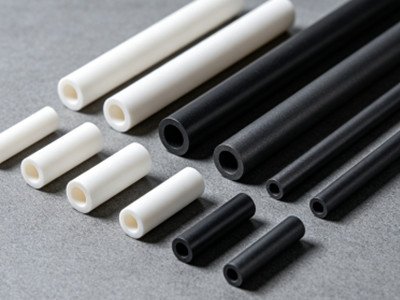
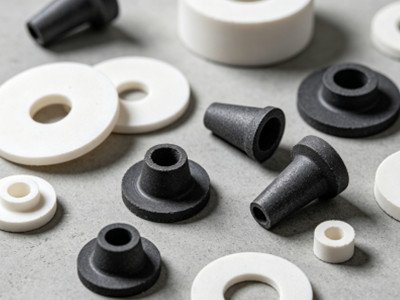
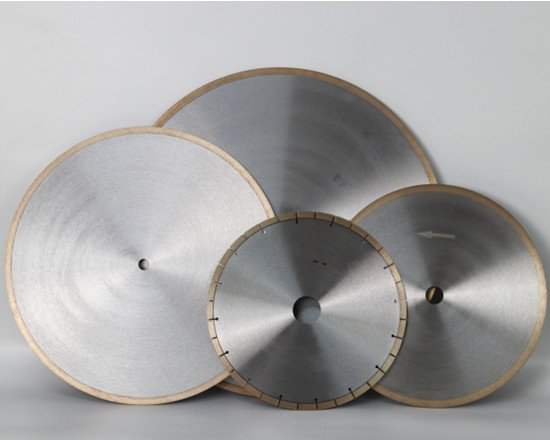
A diamond cutting blade is a professional superhard cutting tool composed of a high-rigidity metal substrate and diamond abrasive grains. Diamond abrasives (Mohs hardness 10) are fixed on the substrate through resin bonding, metal sintering, brazing, or electroplating processes. The tool can steadily cut various high-hardness engineering ceramics while controlling cutting stress, which makes it irreplaceable in industrial ceramic precision machining.
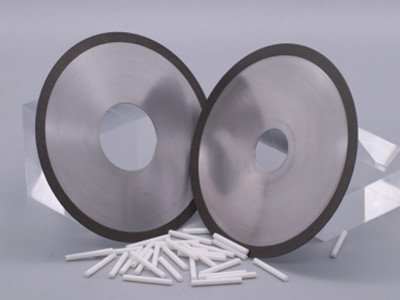
The core technical value of diamond cutting blades lies in their ability to overcome the cutting resistance of ultra-hard ceramic materials. Different from ordinary abrasives, diamond can effectively remove ceramic surface structures without repeated extrusion and low-efficiency grinding. This capability realizes stable cutting of alumina, zirconia, silicon carbide, and silicon nitride structural ceramics.
In precision cutting applications, diamond blades adopt 80–120 mesh fine abrasive gradation and high-rigidity substrate design. The structural optimization reduces cutting vibration and uniformizes stress distribution on the workpiece. The cutting verticality can reach ±0.05 mm, which effectively suppresses edge chipping and internal microcracks and meets the precision requirements of high-end ceramic components.
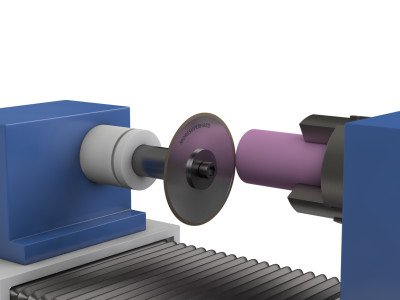
Diamond cutting blades significantly improve production efficiency and finished surface quality for industrial ceramic processing, mainly reflected in three aspects.
First, they provide higher cutting speed. Diamond abrasive sharpness far exceeds traditional grinding materials. The blades support stable fast feeding under both dry-cut and wet-cut conditions, increasing overall processing efficiency by more than 30% and adapting to continuous automated production lines.
Second, they deliver ultra-smooth cutting sections with low surface roughness (Ra). High-quality diamond cutting produces burr-free, flat fracture surfaces, which can reduce or completely eliminate subsequent grinding and polishing procedures. This shortens the production chain and improves overall line throughput.
Third, metal-bonded diamond blades possess excellent thermal conductivity. With coolant-assisted wet cutting, the tool rapidly removes grinding heat, avoids thermal stress-induced microcracks and thermal explosion, and prevents diamond abrasives from high-temperature graphitization failure, ensuring long-term processing stability.
Although diamond cutting blades have higher unit procurement prices, their ultra-high wear resistance greatly reduces comprehensive operational costs. The service life of diamond blades is 5–40 times that of ordinary resin wheels and alloy blades. In high-frequency batch production and thick ceramic cutting scenarios, fewer tool replacements reduce downtime, labor costs, and consumable consumption.
Different bonding systems provide targeted cost reduction for different processes. For mass rough machining of thick ceramic plates and tubes, bronze-sintered and brazed diamond blades offer extremely long service life and low amortized cutting cost. For high-value precision ceramic finishing such as dental ceramics and ceramic substrates, resin-bonded diamond blades provide excellent self-sharpening performance and low chipping rates, effectively lowering workpiece scrap loss.
In actual industrial production, properly selected diamond cutting blades can significantly reduce the unit processing cost of industrial ceramic products.
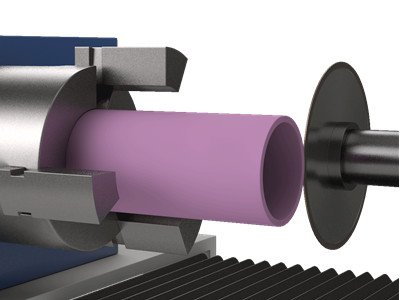
Different bonding technologies enable diamond cutting blades to adapt to diversified industrial ceramic materials and processing requirements, covering precision finishing, rough mass cutting, and micro-component segmentation.
Resin-bonded diamond cutting blades feature outstanding self-sharpening performance, low cutting heat, and minimal edge damage. They are suitable for high-precision processing of electronic ceramic substrates, thin-walled ceramic parts, and zirconia dental ceramics.
Metal-sintered diamond cutting blades have high abrasive holding force, high rigidity, and extreme wear resistance. They adapt to high-load rough cutting of thick alumina ceramics, silicon carbide structural ceramics, and heavy-duty ceramic tubes and plates.
Brazed and electroplated diamond cutting blades provide smooth cutting results and dual dry/wet cutting compatibility. They are widely used for conventional industrial ceramic profiling and trimming.
In addition, ultra-thin diamond blades (thickness ≤0.2 mm) solve the technical difficulties of narrow grooving and micro-segmentation for electronic ceramics, reducing material loss by approximately 40% and supporting the manufacturing of high-precision, high-value ceramic electronic components.
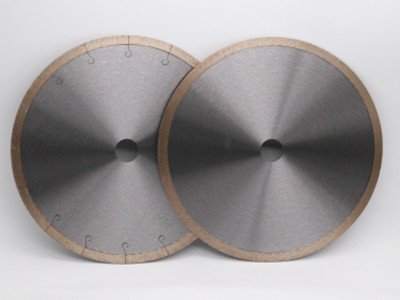
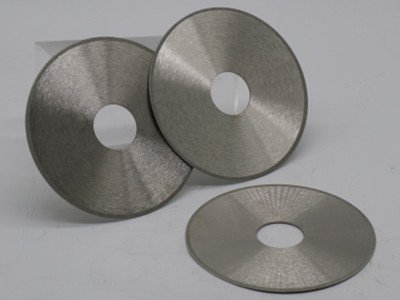
| Cutting Blade Type | Typical Application Scenarios | Core Application Value |
| Resin Bonded Diamond Cutting Blade | Electronic ceramic substrates, zirconia dental ceramics, thin-walled precision ceramic parts | Good self-sharpening performance, low processing heat, minimal edge chipping, dedicated to high-precision finishing of premium precision ceramics |
| Metal Sintered Diamond Cutting Blade | Alumina/silicon carbide structural ceramics, thick-walled ceramic tubes and plates | High bonding strength, excellent rigidity and wear resistance, capable of high-load operation, suitable for mass rough processing |
| Brazed/Electroplated Diamond Cutting Blade | Conventional industrial ceramic profiles and general ceramic component cutting & trimming | Smooth cutting surface, compatible with dry and wet cutting, flexible and versatile for general industrial ceramic processing |
Diamond cutting blades provide indispensable technical support for modern industrial ceramic processing. Their core values include: breaking the processing bottleneck of ultra-hard brittle ceramics that traditional tools cannot handle; improving surface quality and simplifying post-processing procedures; extending tool life and reducing comprehensive production costs; and realizing full-scenario processing coverage through differentiated blade types.
With the widespread application of structural ceramics and electronic ceramics in new energy, semiconductors, aerospace, and medical industries, diamond cutting blades will continue to serve as core precision consumables for high-efficiency, high-precision, and low-cost industrial ceramic manufacturing.