13
Aug
High Speed Steel (HSS) is widely used for drills, taps, milling cutters, broaches, saw blades, gear cutters and other high-performance cutting tools. Because HSS has high hardness, wear resistance and heat resistance, grinding HSS requires an abrasive that can maintain sharp cutting performance under demanding grinding conditions.
For grinding HSS and hardened tool steel, CBN sanding belts are one of the most suitable superabrasive belt solutions.
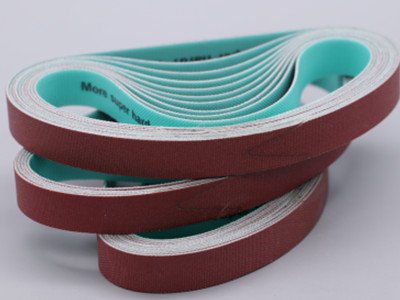
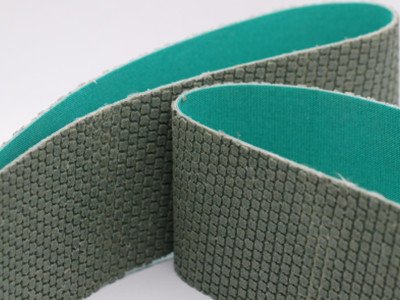
A CBN sanding belt is an abrasive belt coated with Cubic Boron Nitride (CBN) grains. CBN is a superabrasive with extremely high hardness and excellent thermal stability.
Compared with conventional abrasive belts, CBN sanding belts can provide:
CBN is particularly suitable for steel-based materials, making it a preferred superabrasive for HSS grinding.
The main reason is the material compatibility between CBN and high speed steel.
HSS is an iron-based alloy. During grinding, the contact zone can reach high temperatures. CBN has good chemical stability when grinding ferrous materials, while diamond is generally more suitable for non-ferrous materials and hard, brittle materials.
Therefore, for applications involving HSS, high hardness and abrasive grinding, CBN is generally the preferred superabrasive.
CBN sanding belts can be used for both stock removal and finishing operations, depending on the belt construction, grit size and grinding parameters.
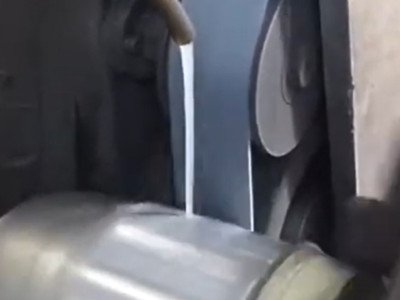
Two common CBN belt constructions are resin-bond CBN sanding belts and electroplated CBN sanding belts.
Resin-bond CBN belts provide a relatively controlled and adaptable grinding action. They can be considered when the application requires:
The actual performance depends on the resin formulation, CBN concentration, grit size and belt backing.
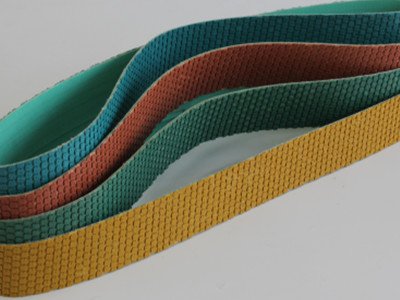
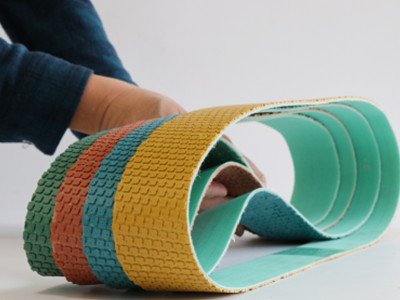
Electroplated CBN belts hold CBN grains firmly on the abrasive surface and can provide high grain exposure.
They are suitable for applications where:
The choice between resin and electroplated CBN should be based on the workpiece, grinding operation, required removal rate and desired surface finish.
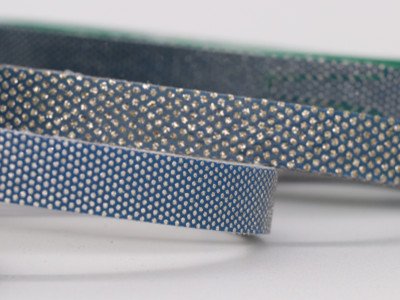
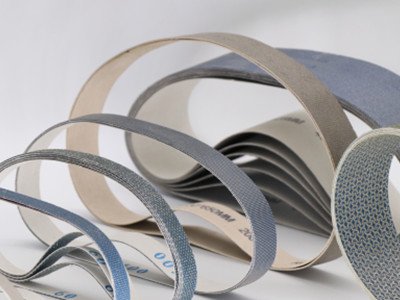
CBN grit selection depends mainly on the amount of material to be removed and the required surface finish.
| Grinding Operation | Typical CBN Grit Selection |
|---|---|
| Heavy stock removal | Coarse CBN grit |
| General grinding | Medium CBN grit |
| Semi-finishing | Medium-fine CBN grit |
| Finishing | Fine CBN grit |
Coarser grains generally provide higher material removal capability, while finer grains are normally selected when surface finish and dimensional control become more important.
The exact grit should be determined together with the HSS hardness, grinding allowance, contact area, machine power, belt speed and cooling conditions.
Yes. CBN is particularly suitable for hardened HSS.
After heat treatment, HSS can reach a high hardness level, making conventional abrasive belts less efficient for certain applications. CBN maintains its cutting capability on hardened steel and can be used for grinding operations after heat treatment.
For hardened HSS, the grinding process should be optimized to control heat generation and prevent grinding burn.
The choice between dry and wet grinding depends on the specific belt construction, machine and application.
For precision HSS grinding, coolant can be beneficial for controlling grinding temperature and maintaining workpiece quality. When dry grinding is required, the belt specification and grinding parameters should be selected specifically for dry operation.
It is important not to assume that every CBN sanding belt is suitable for both dry and wet grinding. The belt manufacturer should confirm the recommended operating conditions.
For HSS grinding, CBN is generally the preferred superabrasive.
| Feature | CBN Sanding Belt | Diamond Sanding Belt |
|---|---|---|
| HSS grinding | Excellent choice | Generally not the first choice |
| Hardened steel | Excellent | Limited suitability |
| Ferrous materials | Highly suitable | Generally less suitable |
| Typical applications | HSS, tool steel, hardened steel | Carbide, ceramics, glass and other hard non-ferrous materials |
The key point is that the hardest abrasive is not automatically the best abrasive for every material. Abrasive selection should consider both abrasive hardness and chemical compatibility with the workpiece.
When selecting a CBN sanding belt for high speed steel, consider the following factors:
Higher hardness usually requires a suitable CBN specification and carefully controlled grinding parameters.
Rough grinding, profile grinding, semi-finishing and finishing may require different belt specifications.
Choose the grit according to material removal requirements and surface finish.
Resin and electroplated CBN belts provide different grinding characteristics.
Determine whether the application requires dry grinding or coolant.
Belt speed, contact wheel, grinding pressure and machine power all influence belt performance.
For HSS and hardened tool steel, CBN sanding belts should generally be considered before diamond sanding belts.
A practical selection approach is:
HSS / hardened tool steel → CBN abrasive → select bond type → select grit size → optimize belt speed and grinding pressure → determine dry or wet grinding conditions.
There is no single CBN sanding belt specification that fits every HSS application. For production grinding, the belt should be selected according to the specific HSS grade, hardness, tool geometry, grinding allowance and machine.
CBN sanding belts are an effective superabrasive solution for grinding High Speed Steel (HSS) and hardened tool steel. Their combination of high hardness, wear resistance and suitability for ferrous materials makes CBN particularly valuable for HSS tool grinding.
For applications involving HSS drills, milling cutters, taps, broaches, saw blades and other hardened cutting tools, the correct CBN grit, bond system and grinding parameters can significantly influence grinding efficiency, belt life and surface quality.
If you are selecting a CBN sanding belt for HSS, the most important parameters to provide are the HSS grade and hardness, workpiece dimensions, grinding operation, required surface finish, machine type and whether coolant is used. These parameters can then be used to determine a more suitable CBN belt specification.
CBN sanding belts are generally one of the best superabrasive options for grinding HSS because CBN is well suited to hardened ferrous materials.
Yes. CBN sanding belts are specifically suitable for grinding hardened high speed steel and other hardened tool steels.
For HSS, CBN is generally preferred over diamond because CBN has better suitability for grinding iron-based materials.
The appropriate CBN grit depends on the grinding operation, material removal requirement, HSS hardness and required surface finish. Coarser grits are generally used for stock removal, while finer grits are used for finishing.
Both can be used for HSS, but the better choice depends on the grinding operation, required material removal rate, surface finish, belt life and machine conditions.