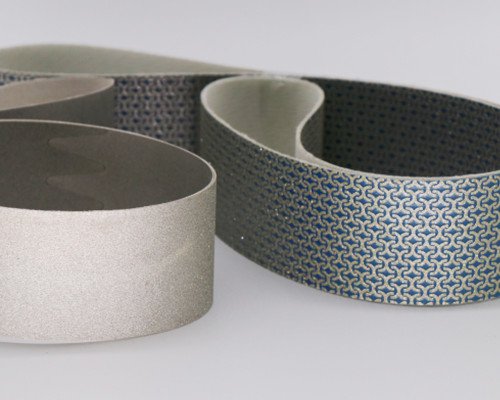
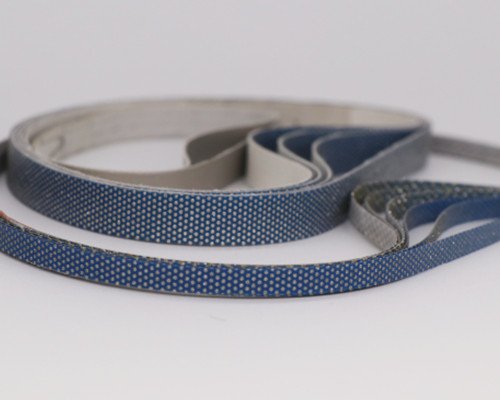
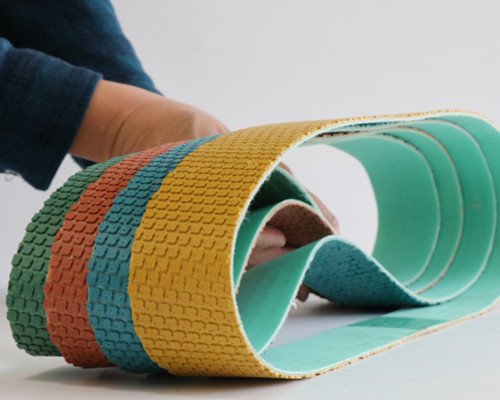
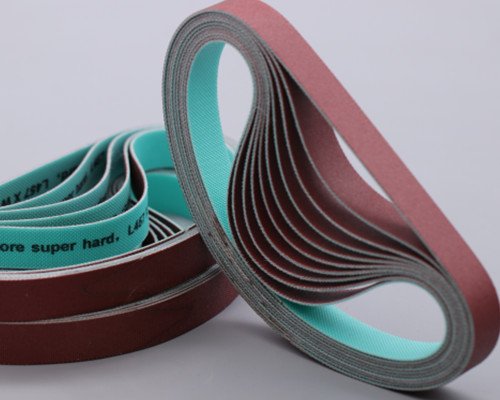
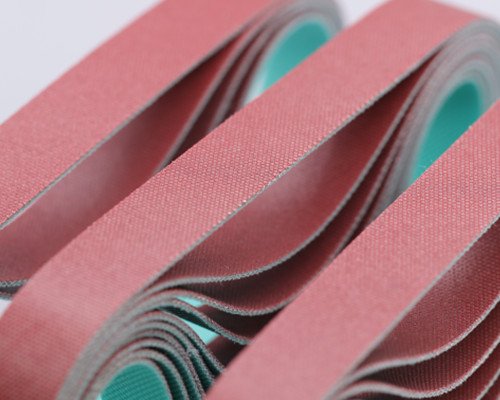
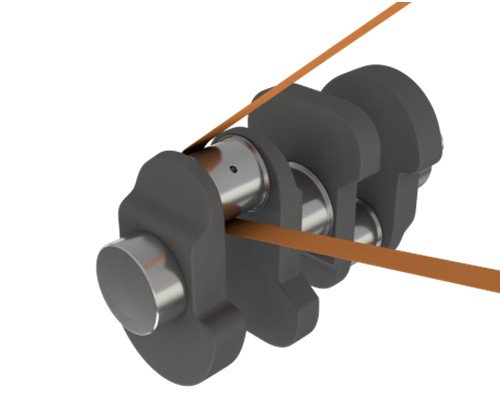
CBN (Cubic Boron Nitride) sanding belts are engineered for grinding and finishing ferrous metals where diamond abrasives are chemically unsuitable. With hardness second only to diamond and superior thermal stability (>1,000 °C), CBN grains maintain sharp cutting edges under high-speed, high-pressure conditions without reacting with iron-group elements — making them the preferred choice for hardened steel, tool steel, and alloy steel processing.
| Feature | Benefit |
| High hardness (7,000–9,000 HV) | Consistent stock removal on hardened steel (HRC 50+) |
| Chemical inertness to ferrous metals | No carbon diffusion; no workpiece contamination |
| Thermal stability >1,000 °C | Withstands high grinding temperatures without grain breakdown |
| Excellent thermal conductivity | Reduces heat buildup, minimizes burn and micro-cracking |
| Self-sharpening crystal fracture | Maintains cutting efficiency throughout belt life |
| Long service life | 3–5× the life of conventional aluminum oxide belts |
| Parameter | Specification |
| Abrasive | Cubic Boron Nitride (CBN) |
| Grit Range | #60 / #80 / #120 / #240 / #400 / #600 / #800 / #1200 |
| Bond Type | Resin bond (flexible / hard) · Electroplated (nickel) bond |
| Backing | Y-weight heavy cloth / Polyester film / Waterproof cloth |
| Width | 10 / 25 / 50 / 75 / 100 / 150 / 200 mm (customizable) |
| Length | 330 / 610 / 1,200 / 2,000 / 3,200 / 4,000 / 6,000 mm (customizable) |
| Concentration | 75% – 125% |
| Operation | Dry or wet grinding |
| Bond Type | Characteristic | Best For |
| Resin Bond (Flexible) | Conforms to complex curves, cool cutting | Profile grinding, finishing, contoured surfaces |
| Resin Bond (Hard) | Rigid, high stock removal rate | Flat surface grinding, heavy deburring |
| Electroplated Bond | Single-layer CBN on nickel, aggressive initial cut | Rapid material removal, shaped profiles, short-run jobs |
| Grit | Application | Surface Finish (Ra) |
| #60 – #80 | Heavy stock removal, deburring, shaping | 3.2 – 6.3 μm |
| #120 – #240 | General grinding, dimensioning | 1.6 – 3.2 μm |
| #400 – #600 | Fine grinding, semi-finishing | 0.8 – 1.6 μm |
| #800 – #1200 | Polishing, mirror finishing | 0.2 – 0.8 μm |
Automotive — crankshaft, camshaft, gear finishing
Aerospace — turbine blade, superalloy component grinding
Tool & Die — mold surface finishing, cutter sharpening
Bearing — raceway precision grinding
General Machining — deburring, blending, surface finishing
Diamond abrasives chemically react with iron at grinding temperatures (carbon diffusion / graphitization), causing rapid wear and workpiece contamination. CBN is inert to ferrous metals, delivers cooler cuts, and maintains dimensional accuracy — the standard choice for all steel-group grinding.
| Item | Details |
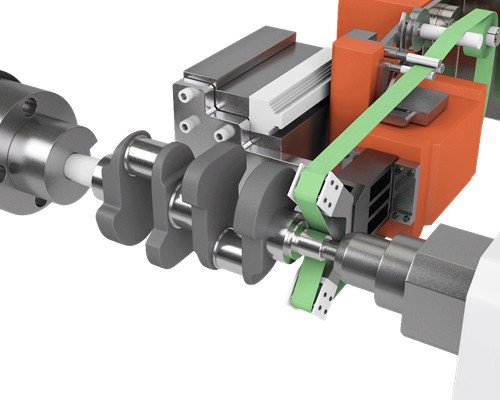
| Workpiece | Automotive crankshaft fillets & camshaft lobes |
| Material | Chilled cast iron / alloy steel (HRC 45–55) |
| Previous Process | Aluminum oxide belts — frequent belt changes, inconsistent Rz, thermal burn risk on fillets |
| CBN Solution | Resin-bond flexible CBN belt, #240 → #600 grit sequence, 50 × 2000 mm |
| Results | Surface roughness stabilized at Rz 2.6–4.0 μm; belt life extended 3×; fillet burn rejection rate dropped from 8% to under 1% |
| Item | Details |
| Workpiece | Transmission gear tooth flanks & edges |
| Material | Carburized alloy steel 20CrMnTi, HRC 58–62 |
| Previous Process | Vibratory finishing + manual honing — long cycle, edge chipping, batch-to-batch variation |
| CBN Solution | Narrow flexible resin CBN belt (10 mm wide), #320 grit, automated tooth-by-tooth finishing |
| Results | Tooth flank Ra reduced to 0.4 μm; edge break uniformly controlled; gear noise level decreased 3–5 dB; cycle time per gear −50% |