05
Jun
K9 optical glass is a soda-lime-silica hard and brittle material with a Mohs hardness of 6 and low fracture toughness. Its grinding process follows dual material removal mechanisms: brittle removal and ductile removal. Under high grinding load, material is removed through crushing and microcrack propagation, which easily causes edge chipping and subsurface damage. Only when the cutting depth of a single abrasive grain is lower than the critical cutting thickness of the material can the glass be removed by ductile flow, realizing crack-free precision processing, which is the theoretical basis for edge mirror polishing. Combined with the standard requirements of optical components, the core processing difficulties are summarized as follows:
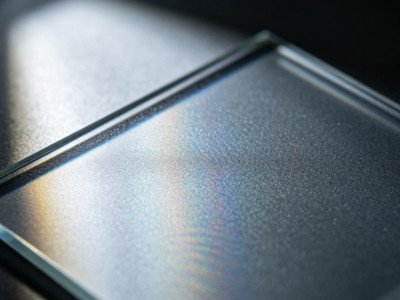

Excessive normal grinding force and instantaneous high temperature will induce micron-scale hidden cracks extending downward from the glass surface, namely subsurface damage. The SSD depth of conventional rough grinding can reach 8~15μm, which not only causes edge defects, but also leads to coating peeling and laser damage failure in subsequent coating and laser application stages, becoming the primary cause of optical glass scrap.
The finished edge requires a surface figure accuracy of λ/10 and a mirror roughness Ra≤0.02μm. Ordinary abrasives and metal-bonded grinding wheels tend to leave deep scratches, failing to meet the non-scattering optical application standards.
The mismatch between resin heat resistance and glass thermal expansion coefficient will cause local thermal stress and micro warping deformation of K9 glass when the instantaneous temperature of the grinding zone exceeds 180℃, damaging dimensional tolerance. Forced cooling and temperature control are mandatory for the whole process.
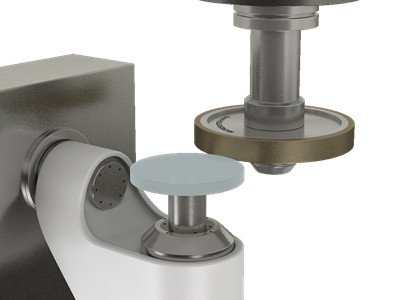
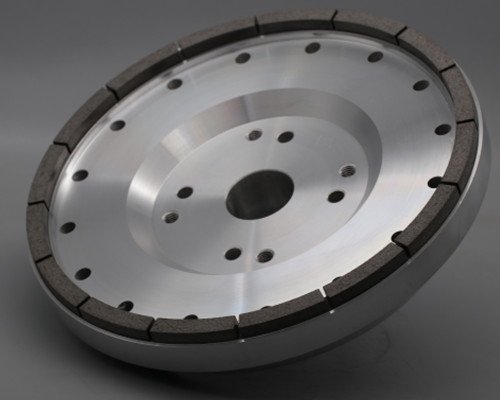
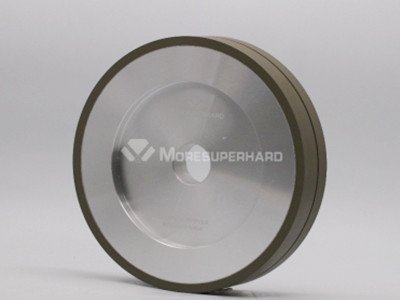
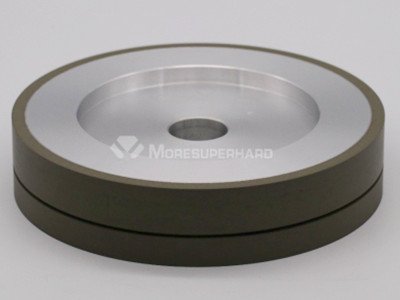
The supporting grinding wheel for this processing is type B resin-bonded diamond wheel with specifications D150×H30×T7×X5×h5 and graded grain sizes of 400#, 800# and 1200#. Customized for graded edge grinding and polishing of K9 glass, resin bond is the optimal base material for optical glass ultra-precision grinding. Compared with metal and ceramic bonds, it has three irreplaceable advantages:
The modified phenolic resin matrix has elastic deformation capability, which buffers the impact load of diamond abrasives during grinding. Compared with metal grinding wheels, the edge chipping rate of workpieces is reduced by more than 60%, perfectly adapting to the light cutting processing of brittle glass.
Grinding friction heat slightly wears the resin matrix, continuously exposing new diamond abrasive grains. The wheel is not easy to passivate and block chips during long-term operation, reducing dimensional fluctuation caused by frequent dressing and improving the stability of batch processing roughness.
The 400#~1200# grain size gradient covers the whole process of margin removal, precision shaping and mirror pre-polishing. The 1000#~1200# ultra-fine grain wheel can directly achieve near-mirror effect, shortening the processing time of subsequent free abrasive polishing.
| Wheel Grain Size | Process Positioning | Processing Target | Achievable Roughness |
| 400# | Rough Grinding & Margin Removal | Remove sawing tool marks and edge defects, single-side removal margin: 0.03~0.06mm | Ra0.4~0.8μm |
| 800# | Semi-finish Grinding & Shaping | Correct edge straightness and dimensional tolerance, reserve 5~15μm polishing margin | Ra0.08~0.15μm |
| 1200# | Ultra-precision Pre-polishing | Mirror pre-processing, control subsurface damage, approach finished surface roughness | Ra0.015~0.03μm |
Wheel Preprocessing
New wheels shall be dressed and sharpened at low speed with white corundum whetstone before mounting to remove protruding diamond particles on the wheel surface, preventing deep subsurface damage and scratches caused by sharp new abrasives. Simple dressing of the wheel surface is required every 8 hours of continuous daily processing.
Workpiece Clamping Protection
Rubber protective gaskets are added for edge processing of thin K9 components to ensure uniform clamping force and avoid hidden cracks caused by local extrusion stress. Workpieces shall be closely attached without gaps during batch stacked grinding to prevent edge chipping caused by grinding fluid infiltration.
Closed-loop Temperature Control
The temperature of the grinding zone is controlled below 120℃ in real time. The grinding fluid shall be filtered regularly to remove glass abrasive debris, as circulating debris will form pitting defects and damage edge surface finish.
Standardized Margin Control
Skipping grain size processes is prohibited. It is not allowed to use 400# wheels for fine polishing or 1200# wheels for large margin removal. Cross-grade processing is the main human-induced cause of batch edge chipping and excessive SSD.
Moresuperhard D150×H30×T7×X5×h5 graded resin diamond wheels (400#~1200#) perfectly match the material characteristics and precision requirements of K9 optical glass edge grinding and polishing. Through graded grain matching and ductile regime grinding parameter optimization, the process balances material removal efficiency and surface integrity, fundamentally solving the industry’s common problems of edge chipping and subsurface damage from the tool end. After the implementation of the complete process, the yield rate of K9 edge processing is increased from 65% to more than 95%. The ultra-precision grinding effect can directly reach the optical mirror standard, which is widely applicable to mass production of high-precision components such as laser lenses, collimating lenses and optical window sheets. For high-end coating-grade optical components, only short-time free abrasive polishing is required after 1200# pre-polishing to meet the λ/10 surface figure accuracy. It is currently the optimal cost-effective complete solution for K9 optical glass edge cold processing.