23
Jul
With booming production of fuel and hybrid vehicles, crankshafts, camshafts and transmission gears are core powertrain components commonly made of 20CrMnTi, 42CrMo and 16MnCr5. After carburizing and quenching, their surface hardness reaches HRC 58~64. In high-volume automated grinding lines, conventional alumina wheels suffer frequent dressing, low efficiency, severe grinding burn and inconsistent dimensional accuracy, failing to meet OEM requirements of CPk ≥ 1.33.
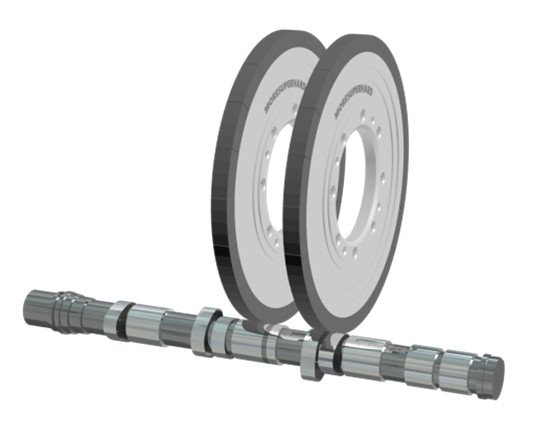
Moresuperhard has years of expertise in automotive precision grinding and launched an all-scenario customized integrated CBN grinding wheel solution. Covering crankshafts, camshafts and transmission gears, the system optimizes wheel formulation, standardized grinding parameters, cooling & dressing routines and in-process quality control across the whole production chain. It enables auto parts manufacturers to boost productivity by 30%~40% and cut overall grinding cost by 40%, completely resolving five major bottlenecks in hardened steel precision grinding.
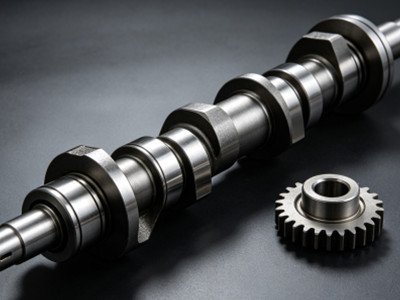
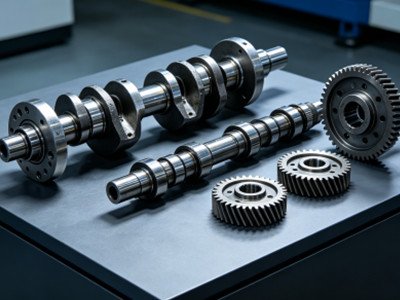
Automotive manufacturing runs million-unit batches. Conventional alumina wheels deliver low material removal rate and require dressing or replacement after dozens of workpieces, cutting effective machine running time below 60% and limiting workshop throughput.
Crankshaft: Roundness & cylindricity ≤3~5μm, diameter tolerance ±0.005mm, surface roughness Ra ≤0.2μm
Camshaft: Cam lift tolerance ≤±0.015mm, phase angle error ≤±3′
Transmission gears: Tooth profile & lead accuracy DIN 4~6, flank roughness Ra ≤0.3μm
Conventional wheels wear rapidly, causing obvious dimensional drift in late production batches and mass defective parts.
Eccentric crankshaft rod journals, non-circular cam lobes and gear tooth slots generate heavy impact load during interrupted cutting. Ordinary wheels easily collapse and lose geometry, increasing labor and abrasive costs from frequent dressing.
Cam lobe tips and gear tooth roots are stress concentration zones. Accumulated grinding heat causes surface temper burn, which leads to fatigue fracture during service. Major OEMs enforce zero burn acceptance standards.
Automakers mandate CPk ≥ 1.33 for all components. Conventional abrasives show uneven wear degradation, resulting in excessive dimensional dispersion after thousands of workpieces and disqualification from high-end customer quality audits.
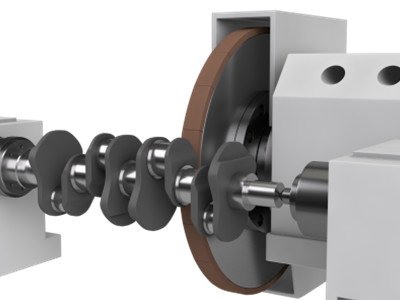
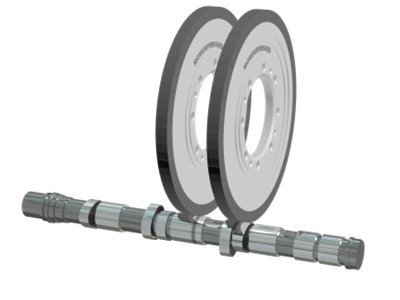
Three core targets: high material removal, stable micron precision and burn-free processing. The solution adopts high-toughness CBN abrasives paired with dedicated vitrified/resin bonds, matched with 80~120m/s high-speed grinding, high-pressure large-flow cooling and closed-loop in-process measurement, compatible with all CNC high-speed grinders for long-term stable automated production.
For differentiated machining conditions of three workpieces, Moresuperhard provides one-stop customization of abrasives, bond, concentration and geometry. Our engineers deliver exclusive wheel drawings and formulation parameters for each project.
| Comparison Item | Ordinary Alumina Wheel | Moresuperhard Custom CBN Wheel | Production Benefits |
|---|---|---|---|
| Hardness | 2000~2500 HV | 4500~5000 HV | Harder than carbides in hardened steel, retains sharp cutting edges long-term |
| Service Life | Dressing needed after dozens of parts | 50~200x longer than alumina | Minimize downtime for wheel change & dressing, raise machine utilization by over 35% |
| Thermal Stability Limit | 1200℃ | Over 1400℃ | Resist softening under high grinding heat, eliminate workpiece burn fundamentally |
| Recommended Abrasive Grade | — | Medium-tough CBN-B | Balances high removal rate and long service life, superior overall cost performance |

High rigidity, high porosity, excellent self-sharpening and thermal stability, outstanding form retention. Ideal for 80~120m/s high-speed grinding, widely applied to crankshaft follow grinding, cam profile grinding and worm wheel gear grinding, standard equipment for mass auto production lines.
Fine grinding texture and superior surface finish, mainly for small-part finish & mirror polishing, suitable for low-volume precision trial production.
Universal Standard Configurations: Abrasive concentration 150%~200%, wheel hardness NR medium-hard grade; high-rigidity steel wheel hub, G1.0 ultra-precise dynamic balancing before delivery. No vibration at speeds above 80m/s, reducing workpiece waviness and machine wear.

Covers three mainstream hardened workpieces: 42CrMo crankshaft, 20CrMnTi carburized camshaft, 16MnCr5 transmission gear. Standard rough/finish/superfinish parameters eliminate repeated on-site trial-and-error.
Wheel speed 60~80m/s, radial infeed per stroke 0.005~0.01mm, workpiece speed dynamically adjusted 50~200r/min based on cam profile. Dressing every 50~80 parts to avoid cam lift curve deviation and guarantee batch contour consistency.
Wheel speed 40~60m/s, radial feed 0.02~0.05mm per stroke with separate rough & finish passes. Vitrified CBN wheels support dressing intervals of 200~500 parts, drastically reducing grinder downtime, maintaining tooth profile & lead accuracy DIN 4~6.
Adopt B64 grit, 200% concentration vitrified CBN multi-step formed wheel, wheel speed 100m/s, rough cut depth 0.2mm, finish cut depth 0.02mm, paired with Marposs in-process gauge closed-loop dimensional control. Result: single journal cycle <30s, workpiece roundness ≤3μm, zero grinding burn. Multiple auto parts manufacturers cooperating with Moresuperhard save over $4,200 annual abrasive cost per workshop.


Grinding heat is the top cause of rejected hardened steel parts. Moresuperhard delivers standardized cooling matching: 4%~8% high-performance extreme pressure emulsified coolant, 15~30bar high-pressure nozzles to break the air barrier at grinding arc, 80~150L/min large flow for continuous heat dissipation, plus ≤20μm precision filtration to prevent fine metal chips from scratching workpiece surfaces.
Automated production lines equipped with diamond dressing rolls for high-efficiency, high-precision contour replication. Single dressing depth controlled at 0.5~1μm/rev to only remove passivated abrasive layers and extend overall wheel life. Intelligent dressing reminder linked to grinding power and workpiece SPC dimensional data, no manual periodic inspection required.
Over a decade of automotive component grinding experience. Customize wheel formulations and geometries according to workpiece material, grinder model, output target and precision requirements. Support custom mold development for multi-step formed, worm and cam special wheels, fully compatible with Junker, Schaudt, Toyoda and all domestic CNC high-speed grinders.
Field feedback from hundreds of OEMs and Tier 1 auto suppliers: wheel service life extended 50~200x, dressing downtime reduced by 70%; single-part grinding efficiency up 30%~40% for direct workshop capacity expansion; scrap rate from burn & dimensional defects cut by 90%, overall single-part grinding cost lowered 35%~45% for fast ROI on wheel investment.
Beyond finished grinding wheels, Moresuperhard provides free one-stop process services: on-site parameter optimization, cooling system transformation, dressing standard formulation and frontline operator training. Full technical delivery from wheel selection to stable mass production, solving workshop process debugging challenges.
Self-owned automated superabrasive production plant for mass vitrified & resin CBN wheel manufacturing. Standard models delivered in 3~7 days, custom special wheels completed in 10~15 days. Regional technical engineers nationwide, 24/7 online technical consultation, on-site support within 48 hours for urgent production line failures.


Against the mainstream trend of high-precision, low-cost and fully automated automotive manufacturing, conventional alumina wheels can no longer satisfy long-term precision grinding of hardened steel. Custom vitrified CBN grinding wheels have become the mainstream upgrade solution for powertrain component machining.
Moresuperhard continuously iterates CBN abrasive formulations, new bonding systems and high-speed grinding supporting processes, launching standardized complete grinding packages for crankshafts, camshafts and transmission gears. Balancing machining precision, production efficiency and comprehensive manufacturing cost, we help domestic auto component manufacturers break grinding process bottlenecks and realize stable independent mass production of high-end parts. Moving forward, the company will develop dedicated CBN grinding solutions for new energy motor shafts and reducer gears, alongside ultra-long-life high-speed bonding formulations, delivering full-chain superabrasive technical support for automotive intelligent precision manufacturing.