21
Aug
The core objective of camshaft grinding is to maintain lobe profile accuracy (lift error ≤0.02 mm) while controlling surface roughness to Ra 0.2–0.3 μm.
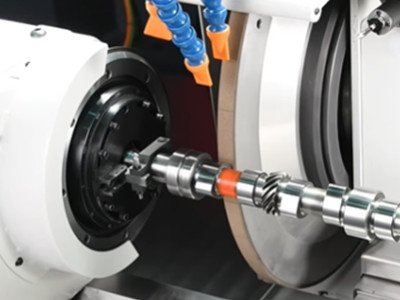
Traditional processing uses a four-stage workflow (roughing → semi-finishing → finishing → polishing). Modern processing has been simplified to two stages: high-speed CNC milling roughing + CBN high-speed finishing grinding. The modern process uses variable workpiece speed curves to ensure consistent material removal rate at all cam points, reducing lift error to 1/3 of traditional methods, shortening cycle time to 1/3, and reducing cost by approximately 1/2.
| Grinding Stage | Stock Removal | Surface Roughness Target |
| Rough grinding | 0.5–1.5 mm | Ra 0.8–1.6 μm |
| Finish grinding | 0.02–0.10 mm | Ra 0.2–0.3 μm |
| Super-finish | <0.02 mm | Ra 0.08–0.15 μm |
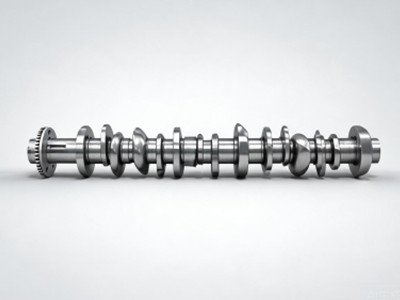
Mainstream camshaft materials fall into two categories: 16MnCr5 case-hardened steel and cast iron (chill cast iron, ductile iron).
After case carburizing and quenching, surface hardness reaches 58–64 HRC with an effective hardened layer depth of 0.6–1.5 mm. The surface layer consists of high-carbon acicular martensite + approximately 10% retained austenite, placing extreme demands on grinding wheels.
Chill cast iron forms a hard white iron layer at the cam lobe tip; ductile iron (e.g., QT600-3) reaches 45–50 HRC after austempering with higher plasticity, making it prone to heat generation during grinding.
Key PointThe 52–64 HRC hardness range exceeds the economic machining range of conventional abrasives, which is the key reason for selecting CBN grinding wheels.
CBN (Cubic Boron Nitride) has a hardness of 4500–5000 HV and is chemically inert to ferrous metals — it does not react at high temperatures (unlike diamond, which undergoes carbon diffusion with iron).
| Property | CBN | Alumina (Al2O3) | Silicon Carbide (SiC) |
|---|---|---|---|
| Hardness | 4500–5000 HV | 2000–2500 HV | 3000–3500 HV |
| Thermal stability | >1400°C | ~1200°C | ~1000°C |
| Compatibility with ferrous metals | Inert, excellent | Machinable | Not suitable |
| Wear resistance | 20–100x higher than alumina | Baseline | Intermediate |
Key advantages of vitrified CBN wheels: G-ratio of 3000–4000, tool life 20–100x longer than alumina, 3–5x higher grinding efficiency, extremely low grinding burn risk, and 50–200 parts per dressing interval.


| Parameter | Rough Grinding | Finish Grinding |
| Grit size | B46–B64 | B126–B181 |
| Concentration | C100–C125 | C125–C150 |
| Hardness | N–R | N |
| Wheel speed | 60–90 m/s | 80–120 m/s |
Mainstream method: diamond roller dressing, completing truing and sharpening in a single pass.
| Parameter | Recommended Range |
|---|---|
| Dressing speed ratio qd | +0.3 to +0.8 |
| Dressing depth of cut | 0.002–0.020 mm/pass |
| Dressing feed rate | 50–500 mm/min |
| Spark-out time | 2–10 seconds |
WarningThe speed ratio must never be set to 1 or close to 1, otherwise the roller will wear or damage rapidly.
Dressing frequency: every 50–100 parts. Sequence: rapid approach → slow feed → spark-out → retraction. No aggressive contact allowed.
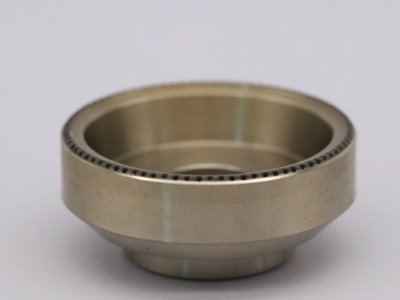

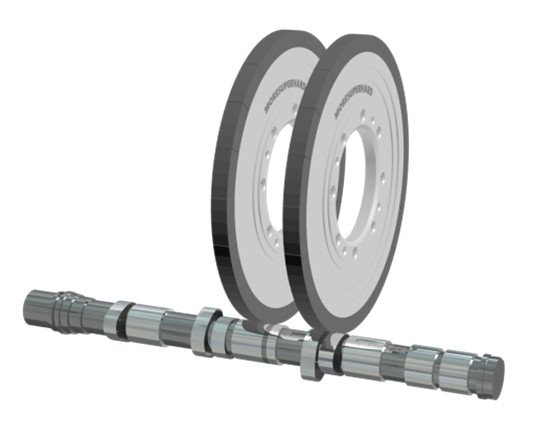
Vitrified CBN Grinding Wheel | Model: OD400‑ID152.4‑W28‑X6
| Item | Details |
| Customer Profile | Overseas automotive component manufacturer |
| Application | Camshaft grinding (replacement for incumbent grinding wheel) |
| Workpiece Material | 16MnCr5 steel, cast iron camshaft |
| Workpiece Hardness after Heat Treatment | 52‑58 HRC |
| Rough Grinding Condition | Stock removal: 1.0 mm per pass |
| Finish Grinding Requirement | Stable surface roughness Ra 0.2‑0.3 μm |
| Challenge | Simple dimension‑for‑dimension wheel replacement cannot guarantee consistent grinding performance. Influencing factors include grinding machine model, dressing method and production cycle time. |
| Solution | Optimized wheel structure, vitrified bond system and dressing parameters rather than direct copy of existing wheel specification. |
| Achieved Results | Improved grinding stability and extended wheel service life |
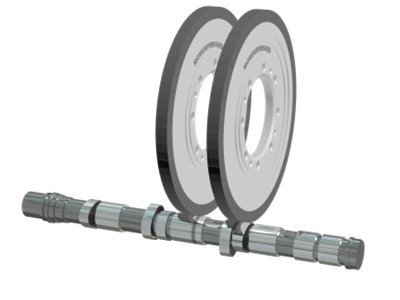
Core selection logic: Ferrous material → CBN → Mass production → vitrified bond → Select grit by Ra → Select softer hardness by workpiece hardness → Select open structure by removal volume. Dressing speed ratio calibration plays a decisive role in grinding stability.
Moresuperhard recommends introducing systematic technical evaluation at the selection stage — coordinating optimization across wheel structure, bond system, and dressing parameters to achieve dual improvements in machining stability and wheel life.