31
Jul
Choosing a diamond band saw blade is not simply a matter of selecting a diamond blade with the right grit. The blade should be matched to the workpiece material, cutting thickness, required surface quality, machine configuration, and cutting conditions.
For hard and brittle materials such as silicon, ceramics, quartz, glass, graphite, and composite materials, the wrong blade specification can result in excessive kerf loss, edge chipping, unstable cutting, short blade life, or poor cutting efficiency.
This guide explains the key factors to consider when selecting a diamond band saw blade.
The first step is to identify the material and its cutting characteristics.
Different materials behave differently during band sawing. Hardness is important, but brittleness, thermal sensitivity, dust generation, workpiece thickness, and the required edge quality also affect blade selection.
| Workpiece Material | Main Cutting Considerations |
|---|---|
| Silicon | Kerf loss, edge chipping, cutting stability |
| Alumina Ceramic | Hardness, brittleness, edge damage |
| Silicon Carbide | Very high hardness and abrasive wear |
| Quartz / Fused Silica | Hardness, dust and edge quality |
| Glass | Chipping and surface damage |
| Graphite | Chip evacuation and loading |
| Carbon-Fiber Composites | Delamination and cutting efficiency |
| Stone / Refractory Materials | Wear resistance and cutting capacity |
For example, a blade designed for high-efficiency rough cutting of a thick refractory material may not be suitable for precision cutting of a thin silicon or ceramic workpiece.
The material should therefore be the starting point for blade selection rather than diamond grit alone.
Diamond grit affects cutting efficiency, surface quality, and edge damage.
In general:
However, grit selection should not be made independently.
A fine grit does not automatically produce better results if the blade geometry, tension, cutting speed, or machine conditions are unsuitable.
For brittle materials such as silicon, glass, and advanced ceramics, the selection should balance cutting efficiency with chipping control.
For abrasive materials, sufficient diamond retention and wear resistance become more important.
Blade thickness is another important parameter, particularly when cutting expensive materials.
A thinner blade can reduce kerf width and material loss.
This can be particularly valuable when cutting:
However, reducing blade thickness also reduces the structural margin of the blade. The blade must still provide sufficient stability for the machine and cutting load.
For heavier workpieces or demanding cutting conditions, a thicker blade may provide better rigidity and stability.
The correct selection is therefore a balance between:
Low kerf loss + sufficient blade stability
rather than simply choosing the thinnest available blade.
Blade width affects cutting stability, rigidity, and the usable cutting geometry.
A wider blade can provide greater support and stability for larger workpieces, while narrower blades can be useful for smaller workpieces or applications requiring more flexibility.
Blade width should be matched to:
The blade must also be compatible with the band saw machine. A blade specification that works well on one machine may not perform the same way on another machine if the machine tension or operating parameters are different.
The edge or tooth configuration determines how the blade interacts with the workpiece.
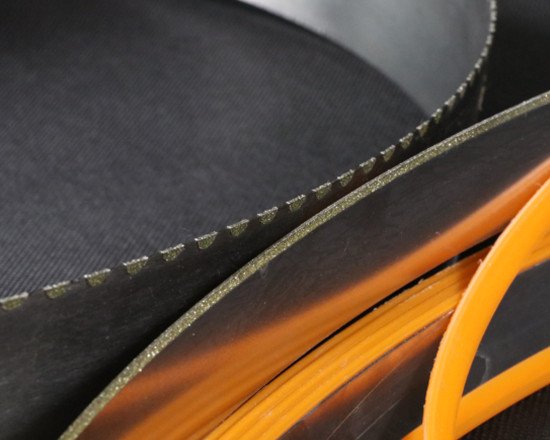
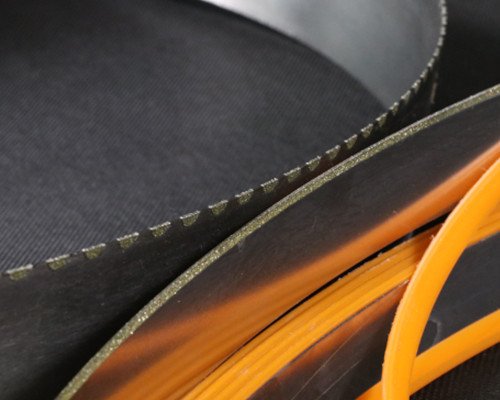
Common configurations include continuous, segmented, semicircular, and serrated designs.
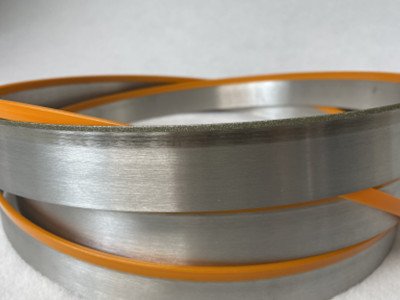
A continuous cutting edge provides a relatively uniform cutting action.
It can be considered when the priority is:
This type of geometry is often relevant to glass, ceramics, and other applications where surface and edge quality are important.
Segmented configurations provide spaces between cutting sections.
The gaps can improve chip clearance and allow greater flexibility in blade design.
They can be useful when cutting:
A buffered tooth geometry can help distribute cutting forces more gradually.
This can be useful for fragile materials where sudden cutting forces may increase the risk of edge chipping or cracking.
Serrated configurations provide greater chip clearance and can be useful for difficult-to-cut or heavily loaded materials.
They are more suitable when cutting efficiency and chip evacuation are important than when the highest possible edge quality is required.
The optimal profile depends on the material, workpiece geometry, and cutting conditions.
The manufacturing method also affects blade performance.
Electroplated blades hold diamond particles on the surface of the cutting area through an electroplated bond.
They can provide:
Electroplated diamond band saw blades are widely considered for applications involving silicon, ceramics, glass, quartz, and other hard or brittle materials.
Metal-sintered blades use a metal-bonded diamond cutting structure.
They can be considered when:
The choice between electroplated and metal-sintered construction should be based on the workpiece, cutting conditions, required blade life, and machine parameters.
Even a correctly specified diamond band saw blade can perform poorly if it is not properly matched to the machine.
Before ordering a blade, check:
Blade length is particularly important because the blade must fit the machine’s wheel configuration and tensioning system.
For production applications, the machine’s actual operating conditions should be considered together with the workpiece rather than selecting the blade from a standard specification table alone.
For materials such as silicon, semiconductor-related materials, optical glass, advanced ceramics, and engineered composites, blade selection can directly affect material yield.
For these applications, the main objective may not be maximum cutting speed.
Instead, the priority may be:
Stable cutting + low kerf loss + controlled edge damage + consistent blade life
For example, when cutting silicon, reducing unnecessary kerf loss can be important because the material itself may have a high processing value.
For advanced ceramics, controlling edge chipping may be more important than simply maximizing feed speed.
This is why a standard blade specification should not automatically be applied to every material.
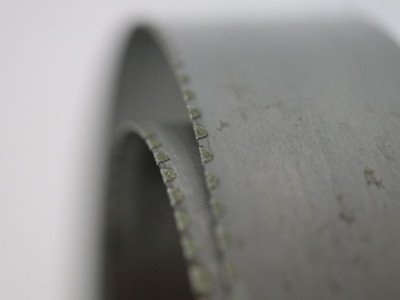
The selection process can be summarized as follows:
Step 1 — Identify the material
Determine whether you are cutting silicon, ceramic, glass, quartz, graphite, composite, stone, or another hard material.
Step 2 — Define the cutting objective
Decide whether the priority is cutting speed, low kerf loss, surface quality, edge quality, or blade life.
Step 3 — Select the blade thickness and width
Balance material loss with the rigidity required by the machine and workpiece.
Step 4 — Select diamond grit
Choose a suitable grit according to the material and required cutting performance.
Step 5 — Select the edge profile
Consider continuous, segmented, buffered, or serrated configurations according to cutting requirements.
Step 6 — Confirm machine compatibility
Check blade length, width, thickness, tension, and operating conditions.
Step 7 — Consider customization
If the standard specification does not match the application, a custom blade can be developed according to the machine and workpiece requirements.
| Selection Factor | Main Question |
|---|---|
| Workpiece material | What material are you cutting? |
| Diamond grit | Do you prioritize cutting efficiency or edge quality? |
| Blade thickness | Is low kerf loss or higher rigidity more important? |
| Blade width | What size and type of workpiece are being cut? |
| Edge profile | Do you need precision cutting or better chip evacuation? |
| Bond / production method | Is the application better suited to electroplated or metal-sintered construction? |
| Machine | What blade dimensions and tension does the machine require? |
| Customization | Are standard blade specifications suitable for the application? |
The right diamond band saw blade is determined by the complete cutting application rather than by diamond grit alone.
For hard and brittle materials, the most important factors are the workpiece material, diamond grit, blade thickness, blade width, edge profile, manufacturing method, and machine conditions.
If you are cutting silicon, ceramics, quartz, glass, graphite, composites, or other difficult-to-machine materials, the blade can be customized according to the workpiece and machine requirements.
Moresuperhard supplies diamond band saw blades in different blade sizes, edge configurations, diamond specifications, and manufacturing methods, with custom solutions available for specific cutting applications.
For a blade recommendation, provide the workpiece material, workpiece size, machine model, current blade specification, and required cutting result.